
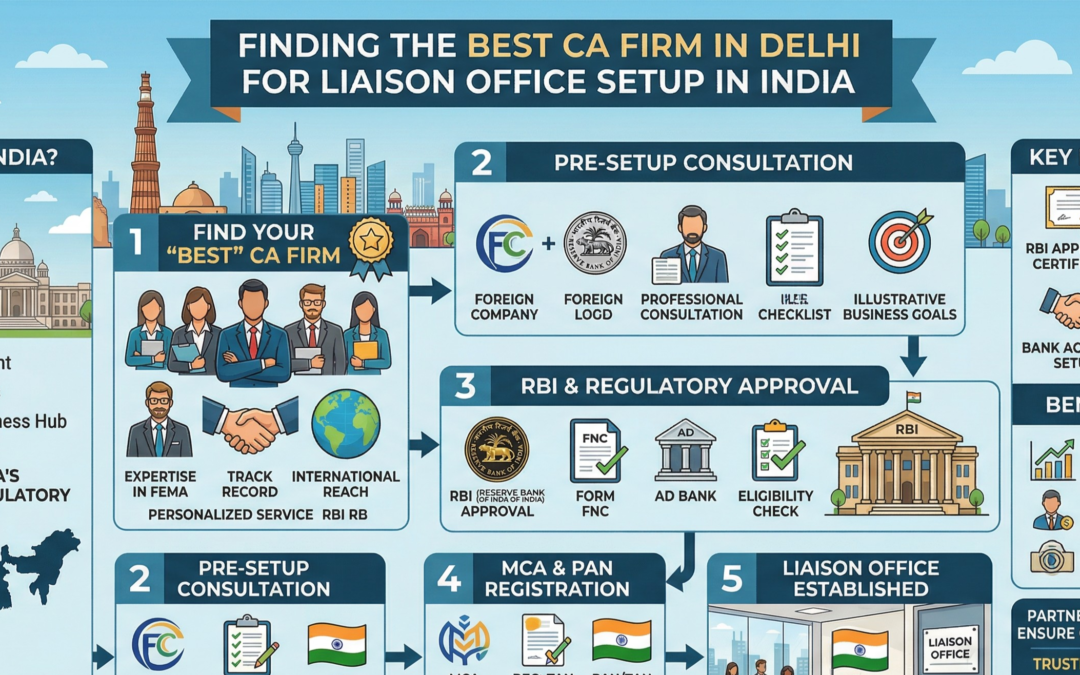
TL;DR
Foreign companies entering India often start with either a Liaison Office (LO) or Project Office (PO). These structures allow international companies to explore the Indian market or execute specific projects without incorporating a full subsidiary.
However, the process Liaison Office requires:
- RBI approval
- FEMA compliance
- Income tax registration
- Annual reporting obligations
Working with an experienced CA firm in Delhi specializing in foreign business setup ensures smooth approval and full regulatory compliance.
Why Foreign Companies Choose India for Expansion

India has become one of the most attractive global markets for international companies.
Key reasons include:
- World’s fastest growing major economy
- Large consumer market of 1.4+ billion
- Government support for foreign investment
- Strategic access to Asian markets
According to government investment data, India consistently attracts billions in foreign direct investment (FDI) annually across technology, infrastructure, manufacturing, and services sectors.
For companies testing the market, a Liaison Office or Project Office is often the first step.
Understanding Liaison Office vs Project Office in India
Foreign companies must select the correct structure depending on their operational goals.
What is a Liaison Office?
A Liaison Office (LO) acts as a communication channel between the foreign parent company and Indian entities.
Permitted activities include:
- Market research
- Promoting parent company products
- Communication with Indian partners
- Facilitating business collaborations
Important restriction:
Liaison offices cannot generate revenue in India.
All expenses must be funded by the parent company abroad.
What is a Project Office?
A Project Office (PO) allows foreign companies to execute a specific project in India.
It is typically established when:
- A foreign company wins a contract from an Indian entity
- The project is funded by international financing agencies
- The contract is approved by Indian regulatory authorities
Unlike liaison offices, project offices can conduct limited business activities related to the project.
Key Differences
| Feature | Liaison Office | Project Office |
|---|---|---|
| Revenue generation | Not allowed | Allowed for project |
| Purpose | Market representation | Execute specific project |
| RBI approval | Required | Required |
| Duration | Usually 3 years | Project duration |
| Activities | Communication & promotion | Project execution |
Choosing the wrong structure can lead to regulatory complications and compliance risks, which is why professional guidance is critical.
RBI & FEMA Regulations for Foreign Liaison Office in India
Foreign company presence in India is governed primarily by:
- Foreign Exchange Management Act (FEMA)
- Reserve Bank of India (RBI) regulations
These regulations control:
- Foreign investment
- Remittance of funds
- Business activities allowed in India
- Reporting obligations
Companies must apply through Authorized Dealer (AD) Banks, and documentation must meet strict regulatory standards.
Step-by-Step Process to Set Up a Liaison Office in India
Step 1: Eligibility Check
Foreign company must meet:
- Profit-making track record of last 3 years
- Minimum net worth of USD 50,000
Step 2: Prepare Application
Submit application through the AD Bank including:
- Form FNC
- Parent company documents
- Financial statements
Step 3: RBI Approval
The RBI reviews the application and issues approval if compliant.
Approval typically takes 4–8 weeks.
Step 4: PAN & Tax Registration
After approval, the liaison office must obtain:
- PAN (Permanent Account Number)
- TAN
- Other registrations if required
Step 5: Bank Account Opening
A local bank account is opened for operational expenses funded by the parent company.
Step-by-Step Process to Set Up a Project Liaison Office in India
Step 1: Project Contract
Foreign company must have a secured project contract with an Indian entity.
Step 2: AD Bank Application
Documents submitted include:
- Project agreement
- Company financials
- Board resolution
Step 3: RBI Compliance
If conditions are satisfied, project offices may be established without separate RBI approval in some cases.
Step 4: Tax Registration
Obtain:
- PAN
- GST registration (if applicable)
Step 5: Operational Setup
Start executing the project under FEMA and tax compliance rules.
Documents Required for Foreign Liaison Office Setup
Typical documentation includes:
- Certificate of incorporation of parent company
- Memorandum and Articles of Association
- Latest audited financial statements
- Board resolution for Indian office
- KYC documents
- Project agreement (for PO)
Documentation errors are a major cause of approval delays, making expert advisory essential.
Compliance Requirements After Setup
Once operational, liaison or project offices must comply with:
- Annual Activity Certificate (AAC)
- Income tax filings
- FEMA reporting
- Banking compliance
- Transfer pricing documentation (in some cases)
Failure to comply may lead to penalties or closure orders.
Why Choosing the Right CA Firm in Delhi is Critical
Foreign companies often face challenges such as:
- Regulatory interpretation
- FEMA documentation
- Tax planning
- RBI communication
A specialized CA firm experienced in international business setup provides:
- Regulatory advisory
- Liaison with RBI & banks
- Documentation support
- Ongoing compliance management
This dramatically reduces approval delays and legal risk.
How Sunil K Khanna & Co. Supports Foreign Businesses
Sunil K Khanna & Co., based in Delhi NCR, assists international companies entering the Indian market with services such as:
- Liaison Office setup
- Project Office registration
- FEMA & RBI compliance
- International taxation
- Corporate structuring in India
Their experience with foreign company compliance and regulatory procedures ensures a structured and compliant market entry.
Suggested internal links:
- Anchor: Foreign company registration services
- Anchor: FEMA compliance advisory
- Anchor: International taxation consulting
Conclusion
India presents enormous opportunities for foreign companies, but regulatory compliance is complex.
Choosing the right structure — Liaison Office or Project Office — is the first strategic decision in entering the Indian market.
Working with an experienced CA firm in Delhi that specializes in foreign business advisory ensures:
- Faster approvals
- Full FEMA compliance
- Efficient tax structuring
For companies planning India expansion in 2026, professional guidance can make the difference between smooth entry and costly regulatory delays.
6. FAQ SECTION
What is a liaison office in India?
A liaison office is a representative office of a foreign company that facilitates communication and market research in India but cannot generate revenue.
Is RBI approval mandatory for liaison office?
Yes. Liaison offices require approval from the Reserve Bank of India through an authorized dealer bank.
How long does liaison office approval take?
Typically between 4 to 8 weeks, depending on documentation and regulatory review.
Can a project office earn income in India?
Yes. A project office can generate revenue related to the specific project it is established for.
What is the difference between branch office and liaison office?
A branch office can conduct business and generate income, while a liaison office is restricted to non-commercial activities.
Do liaison offices need to file tax returns in India?
Yes. They must file annual tax returns and compliance reports, even though they cannot earn revenue.
BLOG BY : Sunil k khanna & Co.