
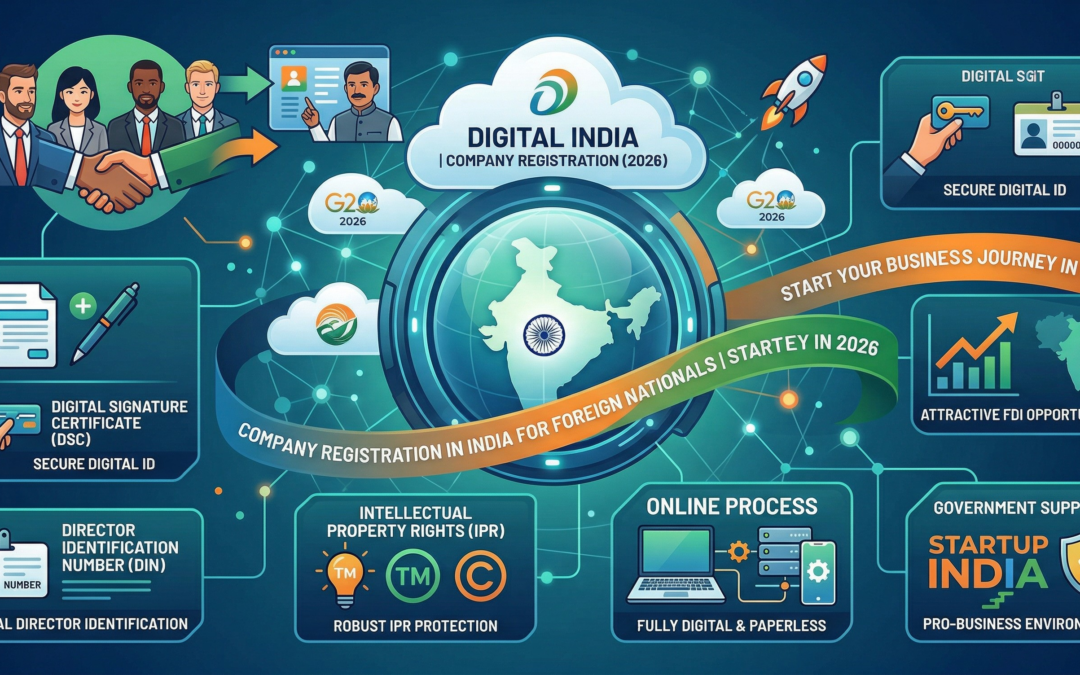
TL;DR
Foreign nationals and NRI entrepreneurs can legally register companies in India under FDI and FEMA regulations. The most common structure is a Private Limited Company, which allows foreign ownership and investment. The process involves Digital Signature Certificates, Director Identification Numbers, company incorporation with MCA, and compliance registrations like PAN, TAN, and GST. Working with an experienced Chartered Accountant ensures faster approvals and regulatory compliance.
Why Foreign Company Investors Choose India
India has become one of the fastest-growing startup ecosystems in the world. With a massive consumer market, favorable government policies, and increasing digital infrastructure, foreign investors are actively establishing businesses in India.
According to the Department for Promotion of Industry and Internal Trade (DPIIT), India receives billions of dollars in Foreign Direct Investment (FDI) every year.

Key reasons investors choose India include:
- Large consumer market
- Rapid digital transformation
- Government initiatives supporting startups
- Strong talent pool in technology and services
Delhi NCR, including Delhi, Gurgaon, and Noida, is one of the most attractive regions for international entrepreneurs.
Can Foreign Nationals Start a Business in India?
Yes. Foreign nationals and NRIs can start businesses in India under the Companies Act 2013 and FEMA regulations.
They can:
- Own shares in Indian companies
- Invest through FDI routes
- Become directors in Indian companies
However, certain regulatory conditions must be followed.
Best Business Company Structures for Foreign Entrepreneurs
Choosing the right structure is the first step in company registration.
| Business Structure | Suitable For |
|---|---|
| Private Limited Company | Most common option for foreign investors |
| Limited Liability Partnership | Suitable for professional firms |
| Wholly Owned Subsidiary | Foreign parent companies expanding to India |
| Joint Venture Company | Partnership with Indian companies |
Among these options, Private Limited Company remains the most preferred structure.
Reasons include:
- Limited liability protection
- Easy investment from foreign investors
- Higher credibility with clients and banks
FEMA & FDI Regulations Explained
Foreign investments in India are governed by FEMA (Foreign Exchange Management Act) and FDI policy guidelines.
There are two primary routes for foreign investment:
Automatic Route
Under this route, foreign investors can invest without prior government approval.
Many sectors such as:
- IT services
- Consulting
- Manufacturing
- E-commerce
allow foreign investment automatically.
Government Approval Company Route
Some sectors require approval from government authorities.
Examples include:
- Defense
- Media
- Telecom
Before registering a company, investors should confirm sector-specific FDI limits.
Step-by-Step Company Registration Process
Foreign nationals and NRIs must follow a structured process to register a company.
Step 1: Obtain Digital Signature Certificate (DSC)
All directors must obtain a Digital Signature Certificate to sign electronic incorporation documents.
Step 2: Apply for Director Identification Number (DIN)
The Director Identification Number is mandatory for company directors.
Step 3: Reserve Company Name
The company name must be approved through the MCA RUN service.
Step 4: File Incorporation Application
The SPICe+ form is submitted with required documents for company registration.
Step 5: Obtain PAN & TAN
Once approved, the company receives:
- PAN
- TAN
- Certificate of Incorporation
Step 6: Open Bank Account & Register GST
After incorporation, businesses must open a bank account and apply for GST if applicable.
Documents Required for Foreign Company Registration
Foreign nationals must submit several documents during incorporation.
Key documents include:
- Passport copy (notarized)
- Address proof of directors
- Passport-sized photographs
- Registered office address proof in India
- Board resolution from foreign parent company (if applicable)
Some documents may require apostille or notarization depending on the country of origin.
Timeline & Cost of Company Setup
The company registration process in India is relatively quick when documents are prepared correctly.
| Process | Time Required |
|---|---|
| Company Name Approval | 1–2 days |
| Incorporation Approval | 3–5 days |
| PAN & TAN issuance | 1–2 days |
Total setup time usually ranges between 7 to 10 working days.
Costs vary depending on services and legal support.
Compliance Requirements After Registration
After incorporation, companies must comply with statutory requirements such as:
- Annual ROC filings
- Income tax returns
- GST returns
- Accounting and auditing
Failure to meet compliance deadlines may result in penalties.
Professional CA firms ensure companies remain compliant with Indian regulations.
Why Delhi NCR is a Strategic Business Hub Company
Delhi NCR has become a major center for global companies.
Advantages include:
- Proximity to government and regulatory bodies
- Strong startup ecosystem
- Access to venture capital and investors
- World-class infrastructure
Cities like Gurgaon are particularly attractive for technology and consulting startups.
Why Work With a Chartered Accountant Firm
Foreign entrepreneurs often struggle with regulatory requirements, documentation, and compliance rules.
A professional CA firm can help with:
- Company incorporation
- FEMA compliance
- GST registration
- Accounting and tax planning
Sunil K Khanna & Co., based in Delhi and Gurgaon, provides expert advisory for foreign investors and NRI entrepreneurs starting businesses in India.
Their team assists with company registration, compliance, taxation, and financial advisory, ensuring a smooth setup process.
If you are planning to start a business in India, consulting experienced professionals can help you avoid costly mistakes and accelerate your launch.
6. FAQ SECTION
Can foreign nationals register a company in India?
Yes. Foreign nationals can register a company in India under FDI regulations, usually through a Private Limited Company structure.
Can NRIs start businesses in India?
NRIs can fully own companies in India and invest through NRE/NRO accounts depending on regulatory conditions.
How long does company registration take in India?
The incorporation process usually takes 7–10 working days if documentation is complete.
What documents are required for foreign company registration?
Passport copies, address proof, photographs, and registered office proof are required along with notarized documents.
Is FDI allowed in Indian startups?
Yes. Many sectors allow 100% FDI under the automatic route, making India attractive for global entrepreneurs.