
TL;DR
When a NRI Non-Resident Indian sells property in India:
• Long-term capital gains tax = 20%
• Short-term capital gains tax = slab rate
• TDS may be deducted up to 20–30% of sale value
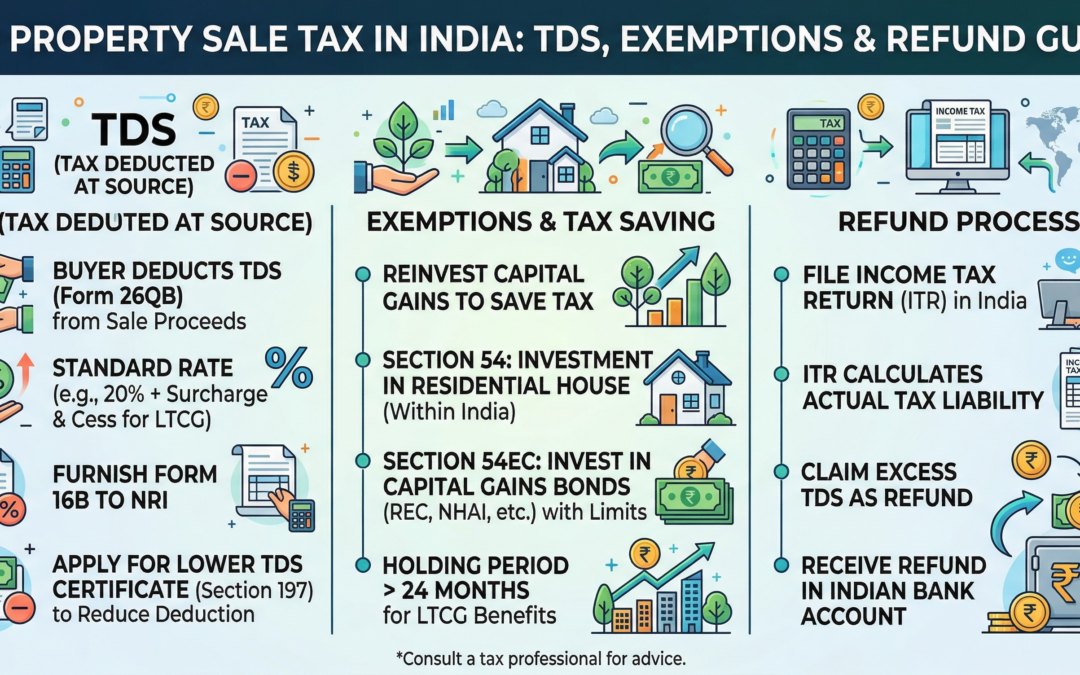
• NRIs can claim tax exemptions under Sections 54, 54F, and 54EC
• Excess TDS can be claimed as refund by filing an income tax return
Proper tax planning can reduce tax liability and improve cash flow significantly.
Income Tax Rules for NRI Selling Property in India

NRIs frequently invest in Indian real estate for:
- long-term appreciation
- rental income
- retirement planning
However, when an NRI sells property in India, taxation becomes more complex than for resident sellers.
The sale is governed by:
- Income Tax Act provisions
- TDS rules under Section 195
- RBI repatriation regulations
Understanding these rules is essential to avoid excessive TDS deductions and unnecessary tax payments.
Capital Gains Tax Rates for NRI Property Sale
Capital gains tax depends on holding period.
| Holding Period | Tax Type | Tax Rate |
|---|---|---|
| Less than 24 months | Short-Term Capital Gain | Slab rates |
| More than 24 months | Long-Term Capital Gain | 20% with indexation |
Long-term gains also allow indexation benefits, reducing taxable profit.
Example:
| Particulars | Amount |
|---|---|
| Purchase price (2012) | ₹40 lakh |
| Indexed cost | ₹75 lakh |
| Sale price | ₹1.2 crore |
| Capital gain | ₹45 lakh |
Tax payable:
20% of ₹45 lakh.
TDS on Property Sale by NRIs (Section 195)
Unlike resident sellers, TDS rules for NRIs are different.
The buyer must deduct TDS under Section 195 of the Income Tax Act.
Tax payable:
20% of ₹45 lakh.
| Situation | TDS Rate |
|---|---|
| Long-term capital gains | 20% |
| Short-term capital gains | Slab rate |
| Plus surcharge & cess | Applicable |
However, in practice many buyers deduct TDS on the entire sale value, not just capital gain.
Example:
Sale price = ₹1 crore
Buyer deducts:
20% of ₹1 crore = ₹20 lakh TDS
Even if actual tax is far lower.
This creates cash flow issues for NRIs.
Why Buyers Deduct Higher TDS NRI
Buyers deduct high TDS because:
• They are responsible for tax compliance
• Incorrect deduction can create penalties
• Calculating capital gain requires documents
To avoid risk, many buyers deduct maximum possible TDS.
Lower TDS Certificate (Form 13)
NRIs can reduce TDS deduction using Form 13 application.
This is known as a Lower Deduction Certificate.
Process:
- Calculate expected capital gain
- Apply online to Income Tax Department
- Submit documents
- Receive reduced TDS certificate
- Buyer deducts tax at lower rate
Benefits:
- Avoid unnecessary cash blockage
- Reduce refund waiting period
Capital Gains Tax Calculation for NRI Property Sale
Capital gains calculation involves:
| Component | Description |
|---|---|
| Sale value | Actual property selling price |
| Less: Indexed cost | Adjusted purchase cost |
| Less: transfer expenses | brokerage, legal fees |
| Net capital gain | Taxable amount |
Indexation uses Cost Inflation Index (CII) published by the tax department.
Tax Exemptions Available to NRIs
NRIs are eligible for the same capital gains exemptions as resident Indians.
Section 54 – Reinvestment in Residential Property
NRIs can avoid capital gains tax if they:
• Purchase another residential property in India
• Within 1 year before or 2 years after sale
Or construct a property within 3 years.
Section 54F – Investment in Residential House
Applicable when:
- Asset sold is not residential property
- Investment made in one residential property
Section 54EC – Capital Gains Bonds
NRIs can invest capital gains in specified bonds within 6 months.
Eligible bonds issued by:
- NHAI
- REC
Maximum investment:
₹50 lakh
Lock-in period:
5 years.
Repatriation of Property Sale Proceeds for NRI
NRIs can repatriate property sale proceeds abroad under RBI rules.
Conditions:
- Maximum USD 1 million per financial year
- Taxes must be paid
- Chartered Accountant certificate required (Form 15CB)
Refund Process After Excess TDS Deduction
If buyer deducts higher TDS, NRIs can claim refund.
Steps:
- File income tax return in India
- Report actual capital gain
- Claim excess TDS refund
- Refund credited to bank account
Refund timeline typically ranges 3–6 months after return processing.
Step-by-Step Compliance Checklist
NRIs selling property should follow this process:
- Calculate capital gains
- Apply for lower TDS certificate (Form 13)
- Buyer deducts TDS and files Form 27Q
- Obtain TDS certificate (Form 16A)
- File income tax return
- Claim refund if excess TDS deducted
Common Mistakes NRIs Make
Not applying for lower TDS certificate
This leads to unnecessary 20–30% deduction on sale value.
Missing tax exemptions
Many NRIs fail to use Section 54 or 54EC benefits.
Incorrect repatriation documentation
Without proper CA certification, banks may delay remittance.
When NRI Should Seek Professional Tax Advice
Professional guidance is essential when:
- Selling inherited property
- Selling jointly owned property
- Repatriating sale proceeds abroad
- Claiming capital gains exemptions
- Applying for lower TDS certificate
Expert tax planning can save several lakhs in taxes.
Conclusion
Selling property in India as an NRI involves capital gains taxation, TDS compliance, and repatriation rules.
Without proper planning:
- Excess TDS may block large funds
- Tax exemptions may be missed
- Refunds may be delayed
With expert tax support, NRIs can:
- Reduce TDS deduction
- Claim maximum tax exemptions
- Ensure smooth repatriation of funds
Need expert assistance with NRI property sale taxation?
Consult Sunil K Khanna & Co., Chartered Accountants in Gurgaon & Delhi, for specialized NRI tax advisory, capital gains planning, and compliance services.
6. FAQ SECTION
What is TDS on property sale by NRIs?
TDS is tax deducted by the buyer under Section 195. The rate may be around 20% for long-term capital gains plus surcharge and cess.
Can NRIs claim Section 54 exemption?
Yes. NRIs can claim Section 54 exemption by reinvesting capital gains in a residential property in India.
How can NRIs reduce TDS on property sale?
They can apply for a Lower Deduction Certificate using Form 13 from the Income Tax Department.
How do NRIs claim refund after TDS deduction?
NRIs must file an income tax return in India, showing actual capital gains and claiming excess TDS as refund.
Can NRIs repatriate property sale proceeds abroad?
Yes, up to USD 1 million per financial year, subject to tax compliance and RBI guidelines.
BLOG BY : Sunil k khanna & Co.