
TL;DR
NRIs Repatriate can legally transfer funds from India to foreign countries through NRE/NRO accounts following RBI and FEMA regulations. The process usually requires Form 15CA, Form 15CB, and a Chartered Accountant certificate confirming that applicable taxes are paid. Professional CA assistance ensures faster approvals and full compliance.
Understanding NRIs Repatriate
Repatriation refers to transferring money from India to another country. NRIs commonly repatriate funds generated from:
- Property sale proceeds
- Rental income from Indian property
- Business income in India
- Investments or dividends
- Inheritance received in India
The Reserve Bank of India (RBI) regulates these transfers under FEMA (Foreign Exchange Management Act).
Without proper compliance, banks will reject the transfer request.
RBI Rules for NRI Fund Transfer
RBI allows NRIs to repatriate funds through specific banking channels.
Key Repatriation Options
| Account Type | Repatriation Allowed |
|---|---|
| NRE Account | Fully repatriable |
| NRO Account | Up to USD 1 million per financial year |
| FCNR Account | Fully repatriable |
For NRO accounts, repatriation requires documentation including CA certification and tax compliance proof.
Documents Required for NRIs Repatriate
Banks typically require the following documents:
- PAN card copy
- Passport copy
- Proof of NRI status
- Source of funds documentation
- Bank request form
- Form 15CA
- Form 15CB issued by a Chartered Accountant
Without these documents, the remittance request will not be processed.
What is a CA Certificate for Repatriation?
A CA certificate is issued by a Chartered Accountant confirming that:
- Applicable taxes in India are paid
- The remittance complies with Income Tax Act and FEMA rules
- The funds being transferred are legitimate
The CA prepares Form 15CB, which is required for most foreign remittances.
This certificate ensures that tax liabilities are properly discharged before funds leave India.
Form 15CB Explained
Form 15CB is a certificate issued by a Chartered Accountant certifying tax compliance for foreign remittances.
It includes:
- Nature of remittance
- Amount being transferred
- Applicable tax deductions
- DTAA (Double Taxation Avoidance Agreement) provisions
Banks rely on this certificate before approving NRI remittance requests.
Form 15CA vs Form 15CB
Many NRIs confuse these two forms.
| Form | Who Files | Purpose |
|---|---|---|
| Form 15CA | Remitter | Declaration of remittance |
| Form 15CB | Chartered Accountant | Tax compliance certificate |
In most cases, Form 15CB must be obtained before filing Form 15CA online.
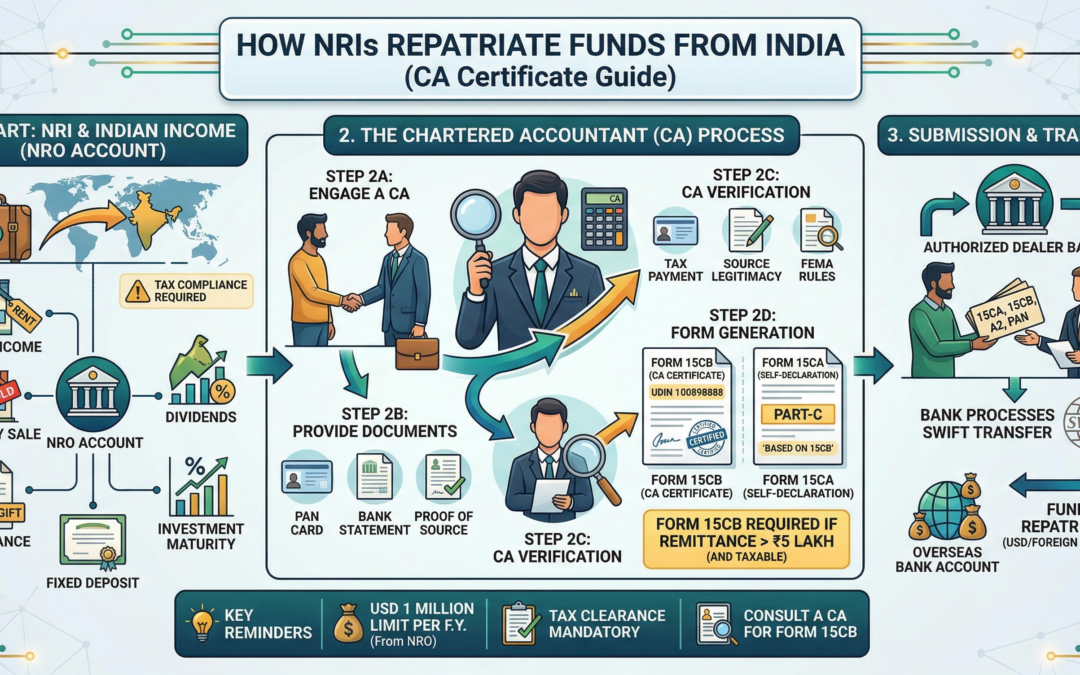
Step-by-Step Process for NRIs Repatriate
The typical process followed by banks is:
Step 1: Collect Documentation
Gather PAN, passport, bank details, and proof of income.
Step 2: Obtain CA Certificate
A Chartered Accountant verifies taxes and prepares Form 15CB.
Step 3: File Form 15CA Online
Submit the declaration on the Income Tax portal.
Step 4: Submit Documents to Bank
Provide:
- Form 15CA acknowledgement
- Form 15CB certificate
- Bank remittance request
Step 5: Bank Processes Transfer
After compliance verification, funds are transferred abroad.
The process usually takes 2–7 working days depending on the bank.
Limits on NRIs Repatriate
The RBI has placed limits on certain remittances.
From NRO Account
- Maximum USD 1 million per financial year
From NRE Account
- No limit if funds are legitimate.
This rule applies to transfers from India to foreign countries.
Tax Implications for NRIs Repatriate
Before repatriating funds, taxes must be cleared.
Common tax scenarios include:
| Income Type | Tax Implication |
|---|---|
| Property Sale | Capital gains tax |
| Rental Income | Income tax applicable |
| Dividends | Tax as per DTAA |
A CA ensures that DTAA benefits are correctly applied, preventing double taxation.
Common Mistakes NRIs Repatriate Make
NRIs often face delays because of documentation errors.
Frequent mistakes include:
- Not obtaining Form 15CB
- Incorrect Form 15CA filing
- Missing proof of income source
- Ignoring tax liabilities
Working with a qualified Chartered Accountant prevents such issues.
Why Professional CA Assistance Matters
Repatriation involves tax law, FEMA compliance, and RBI regulations. A professional CA ensures:
- Accurate tax calculation
- Correct documentation
- Faster bank processing
- Compliance with international remittance laws
Sunil K Khanna & Co., based in Delhi and Gurgaon, provides specialized services for NRI taxation, CA certification, and foreign remittance compliance.
If you are planning to repatriate funds from India, professional guidance can simplify the entire process.
Need help with Form 15CB or NRIs Repatriate?
Consult the experts at Sunil K Khanna & Co. for complete compliance support.
6. FAQ SECTION
What is NRIs Repatriate from India?
NRI repatriation refers to transferring funds earned or held in India to a foreign country through authorized banking channels following RBI and FEMA regulations.
Is Form 15CB mandatory for foreign remittance?
Form 15CB is required in many cases where tax compliance verification is necessary before funds are remitted abroad.
What is the repatriation limit from an NRO account?
NRIs can repatriate up to USD 1 million per financial year from an NRO account.
How long does NRIs Repatriate fund take?
The process typically takes 2 to 7 working days, depending on documentation and bank verification.
Can NRIs repatriate property sale proceeds?
Yes, NRIs can repatriate sale proceeds of property in India after paying applicable taxes and obtaining CA certification.