
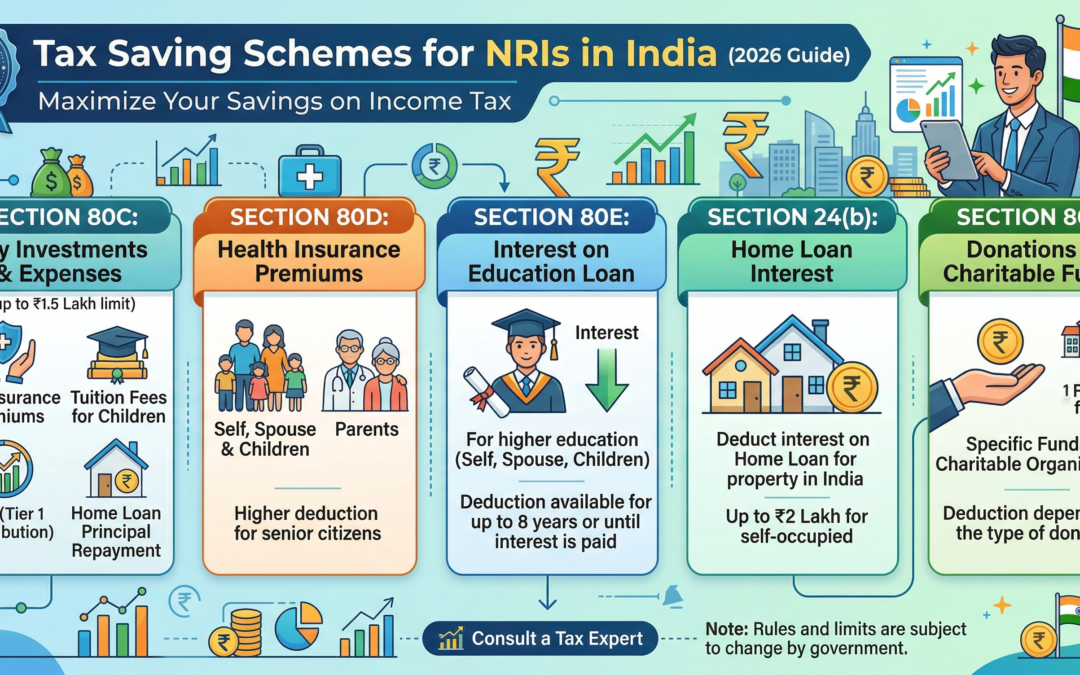
TL;DR
- NRIs earning income in India must comply with Indian tax laws or Tax Saving .
- Several tax deductions and investment schemes help reduce tax liability.
- Key Tax Saving tools include Section 80C investments, capital gains exemptions, and NRE account benefits.
- Strategic planning can significantly increase post-tax returns.
- Consulting experienced tax professionals ensures compliance and optimization.
Why Tax Planning Is Important for NRIs
India remains one of the most attractive investment destinations for Non-Resident Indians. Many NRIs invest in:
- Real estate
- Mutual funds
- Fixed deposits
- Equity markets
However, income from these sources may attract significant tax deductions or TDS.
Without proper planning, NRIs may:
- Pay higher taxes than required
- Miss legitimate deductions
- Face compliance notices
Effective tax planning ensures that investments remain profitable and legally optimized.
Key Tax Rules Every NRI Should Know
Before exploring tax saving schemes, NRIs must understand certain taxation principles.
Residential Status
Tax liability depends on the residential status defined under the Income Tax Act.
Taxable Income for NRIs
NRIs are taxed only on income earned or received in India, such as:
- Rental income from Indian property
- Capital gains from asset sales
- Interest income from Indian investments
Income earned abroad generally remains outside Indian taxation.
Top Tax Saving Schemes for NRIs in India
Several tax saving provisions help NRIs legally reduce their tax liability.

Section 80C Investments
NRIs can claim deductions of up to ₹1.5 lakh annually through eligible investments.
Eligible options include:
- Equity Linked Saving Scheme (ELSS)
- Life insurance premiums
- Principal repayment of home loans
- Tuition fees for children
These investments reduce taxable income while building long-term wealth.
NRE Account Benefits
NRE accounts offer unique tax advantages.
Key benefits include:
| Benefit | Details |
|---|---|
| Interest income | Completely tax-free |
| Repatriation | Fully repatriable |
| Currency conversion | Maintained in Indian Rupees |
This makes NRE accounts one of the most efficient financial tools for NRIs.
Tax-Free Bonds
Government-backed tax-free bonds provide stable returns without tax liabilities on interest income.
These are particularly attractive for NRIs seeking low-risk tax-efficient investments.
Capital Gains Tax Exemptions for NRIs
Property sales often trigger significant capital gains taxes for NRIs.
However, several exemptions are available.
Section 54
Capital gains can be exempted if proceeds are reinvested in residential property.
Section 54EC
NRIs can invest capital gains into government-approved bonds to claim exemptions.
Section 54F
Applies when capital gains from asset sales are invested in residential property.
Investment Options with Tax Benefits
NRIs seeking tax-efficient investments should consider diversified portfolios.
Popular Options
| Investment | Tax Benefit |
|---|---|
| ELSS Mutual Funds | Section 80C deduction |
| NRE Fixed Deposits | Tax-free interest |
| Insurance Policies | Section 80C deduction |
| Infrastructure Bonds | Capital gains exemption |
These investments help combine wealth growth and tax efficiency.
Step-by-Step NRI Tax Planning Strategy
Step 1 – Review Income Sources
Identify taxable income from Indian investments.
Step 2 – Claim Eligible Deductions
Apply tax deductions such as:
- Section 80C
- Capital gains exemptions
Step 3 – Use Tax Efficient Investments
Allocate funds to tax-saving instruments.
Step 4 – File Income Tax Return
Filing returns ensures:
- Compliance
- Refund claims if excess tax deducted
Common Tax Mistakes NRIs Make
Many NRIs unintentionally increase their tax burden.
Typical mistakes include:
- Ignoring tax deductions
- Incorrect residential status reporting
- Not filing ITR after TDS deductions
- Improper capital gains calculations
Professional tax planning prevents such issues.
Why Professional NRI Tax Advisors Matter
Managing cross-border taxation requires specialized expertise.
Experienced advisors help with:
- NRI tax return filing
- Capital gains planning
- FEMA compliance
- Investment tax structuring
Firms such as Sunil K Khanna & Co. provide comprehensive NRI tax advisory services, helping overseas investors remain compliant while maximizing financial returns.
Conclusion
For NRIs investing in India, effective tax planning is essential to protect and grow wealth.
By using legitimate tax-saving schemes such as:
- Section 80C deductions
- Capital gains exemptions
- NRE account benefits
NRIs can significantly reduce tax liability while increasing investment returns.
Professional guidance ensures compliance with evolving tax laws and helps build a structured long-term financial strategy.
6. FAQ SECTION
What tax benefits are available for NRIs in India?
NRIs can claim deductions under Section 80C, capital gains exemptions, and enjoy tax-free interest on NRE accounts.
Can NRIs invest in tax-saving mutual funds?
Yes. NRIs can invest in ELSS mutual funds, which qualify for Section 80C tax deductions.
Do NRIs pay tax on NRE account interest?
No. Interest earned on NRE accounts is fully tax exempt in India.
Can NRIs claim home loan tax benefits?
Yes. NRIs can claim deductions for principal repayment and interest on home loans.
How can NRIs reduce capital gains tax in India?
NRIs can claim exemptions under Sections 54, 54EC, and 54F by reinvesting capital gains in approved assets.
BLOG BY : Sunil k khanna & Co.